
Creating the Multiplier Effect
We spend enormous effort architecting our buildings.
Where should the walls go?
How should the structure work?
How will people move through the space?
How will all the different systems come together?
We deliberately design the physical environment to create the outcomes we want.
But what about the environment in which the project team works?
Let's call that a different kind of architecture:
Context Architecture.

The idea is simple.
We can't do everything ourselves.
We can't attend every meeting, solve every problem, review every detail, or make every decision.
And as projects become larger and more collaborative, trying to do so doesn't make us more valuable.
It makes us the bottleneck.
So how do we multiply our impact?
How do we take one person's experience and judgment and create an environment where ten other people can make better decisions because of it?
That's the multiplier effect.
If your expertise only works when you're personally in the room, your impact is limited by your time.
But create the right context for other people to exercise their own expertise and judgment, and your impact can extend far beyond the decisions you make yourself.
That's leverage.
And that's where Context Architecture comes in.
Context Architecture means deliberately designing the environment around a problem so other people have what they need to exercise their own expertise and judgment.
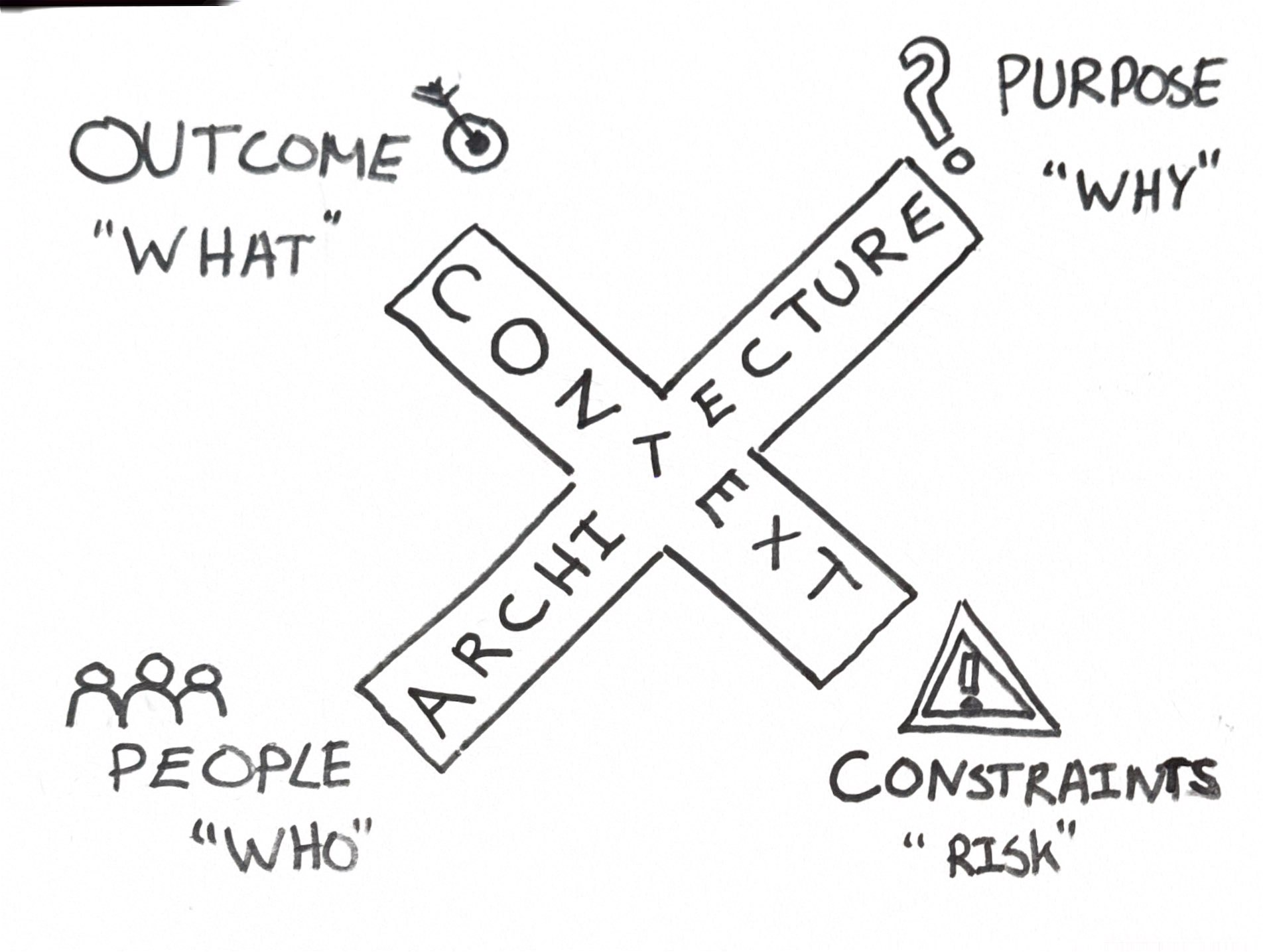
We think good context comes down to five things:
Purpose → Why?
Why are we doing this? What problem are we actually trying to solve?
Outcome → What?
What are we trying to achieve? What does success need to look like?
Constraints → What are the boundaries?
What's fixed? What's flexible? What can't we violate?
People → Who?
Who has the knowledge, experience, authority, or perspective we need?
Think about how different a project conversation becomes when those five things are clear.
Instead of telling a structural engineer:
"Remove this column."
We might say:
"The owner needs this space open so it can be reconfigured in the future. That's the priority. We have 600 mm of structural depth, we can't move the mechanical services, and we need to stay within the structural budget. Who else should be involved before we decide how to solve it?"
Same problem.
Completely different context.
We're no longer telling an expert what the answer should be.
We're giving the team what they need to find a better answer together.
Now imagine doing that across an entire project.
A great project leader doesn't need to personally solve hundreds of problems.
They need to create the context that allows hundreds of better decisions to happen without them.
That's the multiplier effect.
And it's one of the real opportunities of collaborative delivery.

A Big Room isn't valuable simply because forty people are sitting in it.
Early trade involvement isn't valuable simply because another person attends the meeting.
The opportunity is what happens when their knowledge becomes available to everyone else.
When the owner, architect, engineers, contractor, and trades understand the same purpose, desired outcome, priorities, and constraints, the expertise available to every decision multiplies.
One person's understanding becomes ten people's context.
Ten people's expertise becomes available to one problem.
The team becomes capable of far more than any one person could accomplish individually.
Not working ten times harder.
Not attending ten times as many meetings.
Not making ten times as many decisions yourself.
Creating the context that allows the people around you to make better decisions without you.
That’s the multiplier effect.
We don't just need to architect great buildings.
We need to architect the context that multiplies the people creating them.