
The Alpha in the Room
In finance, there’s a term called Alpha.
Most investors have access to the same information.
Stock prices.
Financial statements.
Interest rates.
Earnings reports.
Economic forecasts.
Having access to that information doesn’t automatically give anyone an advantage.
Alpha is the edge.
It’s the insight, judgment or experience that allows someone to see something others don’t and make a better decision because of it.

We think the building industry has alpha too.
We all read the same Building Code.
We use the same design standards.
We can access the same specifications, product literature, drawings, and increasingly, the same AI tools.
That’s our shared information.
Then there’s everything you can’t simply look up.
Ask a structural engineer:
“Can we remove this column?”
The answer is almost always some version of:
“Yes, but…”
Yes, but the transfer beam gets deeper and now it conflicts with the ductwork.
Yes, we can span forty feet without it, but the floor may become noticeably more flexible under foot traffic.
Yes, the alternate slab system solves one problem, but it creates congestion somewhere else.
Yes, post-tensioning helps with depth, but now the stressing sequence affects formwork stripping and schedule.
The Code can tell us what’s permitted.
It can’t always tell us what’s wise.
That knowledge lives elsewhere.
It’s in the engineer who has detailed that connection before and watched it become a problem.
It’s in the formwork contractor who spots one small change that could save weeks.
It’s in the superintendent who knows a detail that looks elegant on paper will be miserable to build.
It’s in the rebar detailer who sees congestion before the bars ever reach the site.
It’s in the owner who remembers the one decision from their last building that everyone still regrets.
That’s our alpha.
It’s the accumulated experience and judgment that lets a team make a better decision than the information alone would suggest.
Experience creates alpha.
But there’s a problem.
Most of it lives inside people’s heads.
One project at a time.
One conversation at a time.
And too often, it disappears when someone retires, changes firms, or simply isn’t in the room when the decision gets made.
That’s where collaboration matters.
Collaboration unlocks alpha.
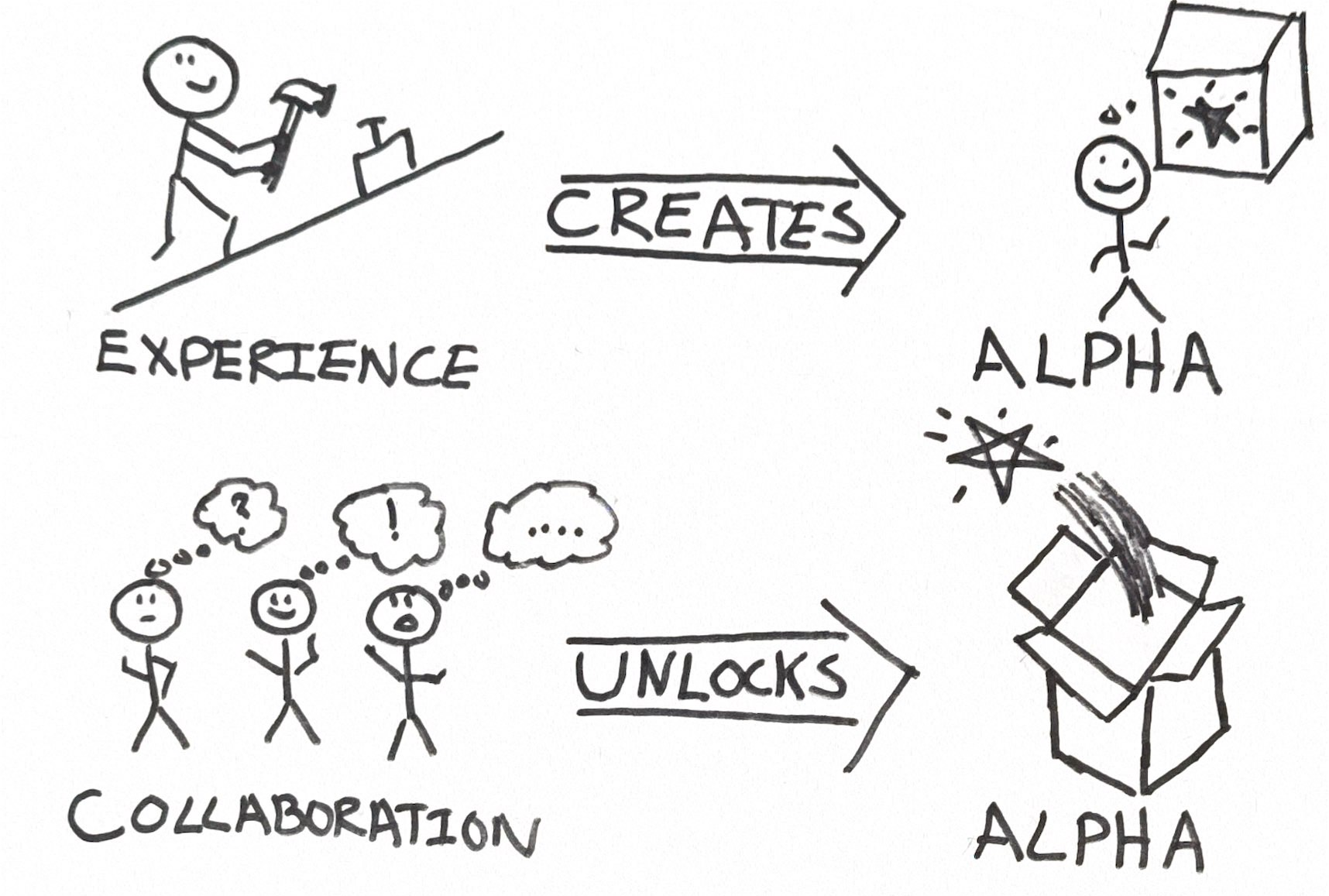
The earlier we bring the right people into the design process, the earlier we gain access to what they know.
The contractor sees something the engineer doesn’t.
The detailer catches something the model misses.
The owner provides context no drawing can show.
The operator remembers what happened last time.
And that knowledge is most valuable before the decision is made.
Because once the decision is locked in, experience can still identify the problem.
It just becomes more expensive to use.
So the next time someone on your team says:
“It depends.”
Don’t rush past it.
That may be the most valuable sentence in the room.
Stop and ask:
What do you know that I don’t?