
Big Rocks Before Bike Racks
The building is millions over budget.
The schedule is slipping.
The owner is quietly wondering whether the project still delivers what they actually need.
And the team just spent thirty minutes discussing bicycle storage.
Sound familiar?
In 1957, British historian C. Northcote Parkinson described a committee reviewing plans for a nuclear power plant.
The plant was technically complex, financially significant and enormously consequential.
Yet it received surprisingly little discussion.
Instead, the committee spent most of its time debating a modest bicycle shed.
Why?
Because everyone understood the bike shed.
Everyone had an opinion.
Everyone felt qualified to contribute.
Parkinson called this the Law of Triviality: the amount of discussion something receives is often inversely proportional to its importance.
Today, we simply call it bike-shedding.
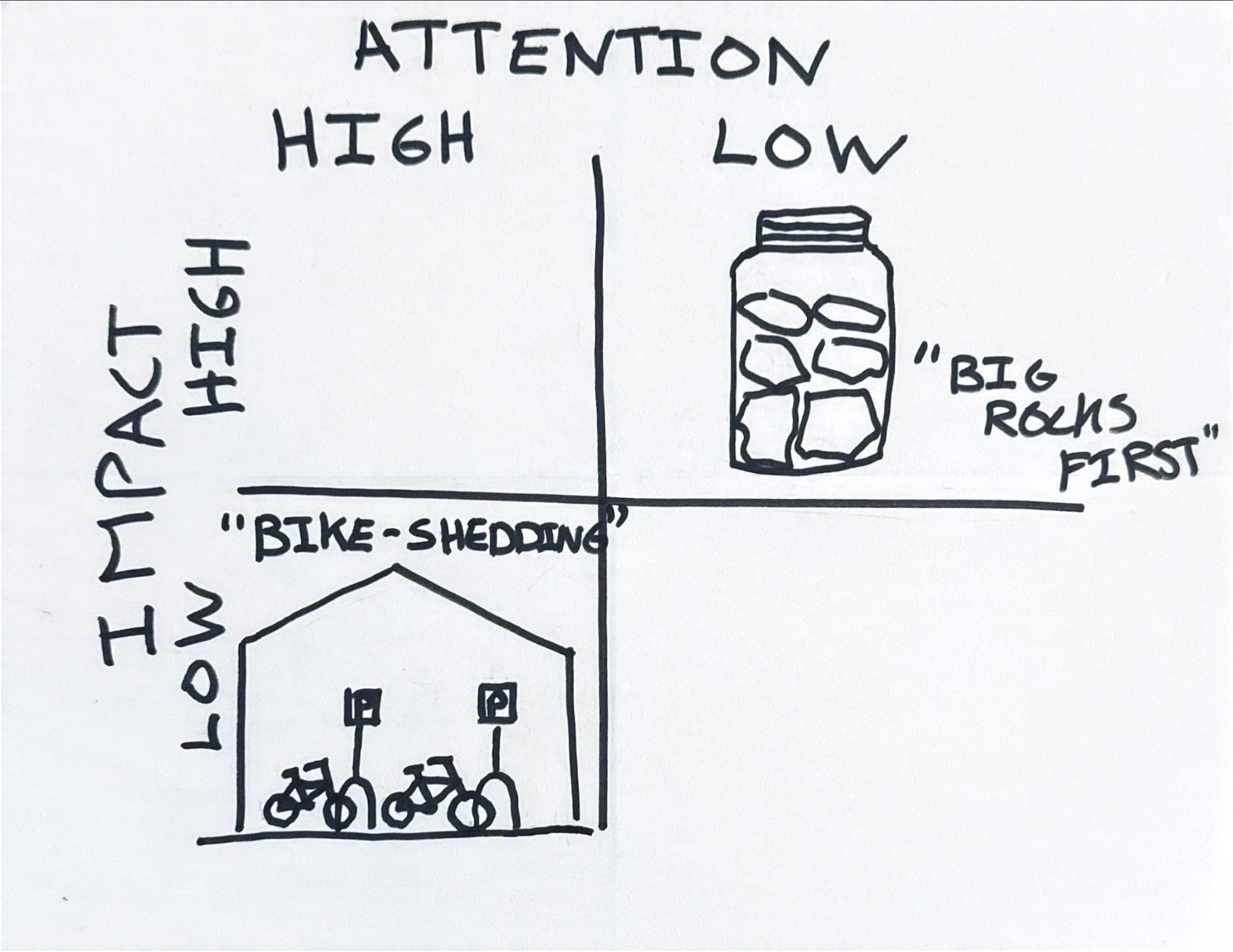
It happens on projects more often than we'd like to admit.
The difficult conversations require uncertainty.
They force us to wrestle with risk, cost, constructability, sequencing, operations and whether we're solving the right problem in the first place.
Those conversations can be uncomfortable.
A bike rack is easy.
Everyone knows what one looks like.
Everyone has used one.
The discussion feels productive because everyone is participating.
Meanwhile, the decisions that will determine the success or failure of the project quietly wait their turn.
This isn't an argument against details.
Great buildings are collections of great details.
The door handle.
The threshold.
The lighting.
The acoustics.
The finish that makes a space feel warm instead of institutional.
Those details matter deeply.
They simply matter after the highest-impact decisions are understood.
Great teams know when to zoom out and when to zoom in.
First ask:
Are we solving the right problem?
Can the project still meet its budget?
What are the biggest risks?
What decisions will have the greatest downstream impact?
Only then is it time to ask:
Where should the bike racks go?
Which finish works best?
How should this detail be executed?
The order matters.

You've probably heard the analogy about filling a jar.
Put the small rocks in first and the big rocks won't fit.
Projects work the same way.
And the larger the meeting becomes, the harder this gets.
One conversation about a familiar detail can quietly consume an hour.
This is especially true in collaborative delivery environments.
Integrated Project Delivery (IPD) Big Rooms are incredibly powerful because they bring the right people together early.
That diversity of expertise is exactly what makes them successful.
But it also creates a challenge.
The more people in the room, the stronger the pull toward the topic everyone feels comfortable discussing.
Without structure, collaboration can drift toward comfort instead of impact.
That's why great collaboration also requires great facilitation.
Not to control the conversation.
To protect it.
A few simple habits can make an enormous difference:
• Start with the hardest decision first.
• Clearly identify whether the discussion is focused on strategy or execution.
• Time-box detailed discussions.
• Capture lower-priority items in a parking lot instead of letting them consume the meeting.
• Give someone permission to ask, "Is this the most important conversation we could be having right now?"

The best project teams don't ignore details.
They sequence them.
Because when the big rocks are in place, the bike racks usually find the right home.
What conversations deserve your attention first?