
Boundaries Drive Behavior
What if you didn't have to manage every behavior on your team?
What if the right boundaries helped the team manage itself?
We often ask,
"How do we get better people?"
But perhaps the better question is:
How do we design a system that helps the people we already have perform better together?
Most of us don't ask for more constraints.
We don't hope for a tighter budget, a shorter schedule, a more challenging site, or another rule to follow.
Constraints feel limiting.
They sound like the enemy of creativity.
But what if the opposite is true?
What if the right constraints are some of our best teachers?
They focus our attention.
They encourage exploration.
They create fast feedback.
They force adaptation.
They break old habits.
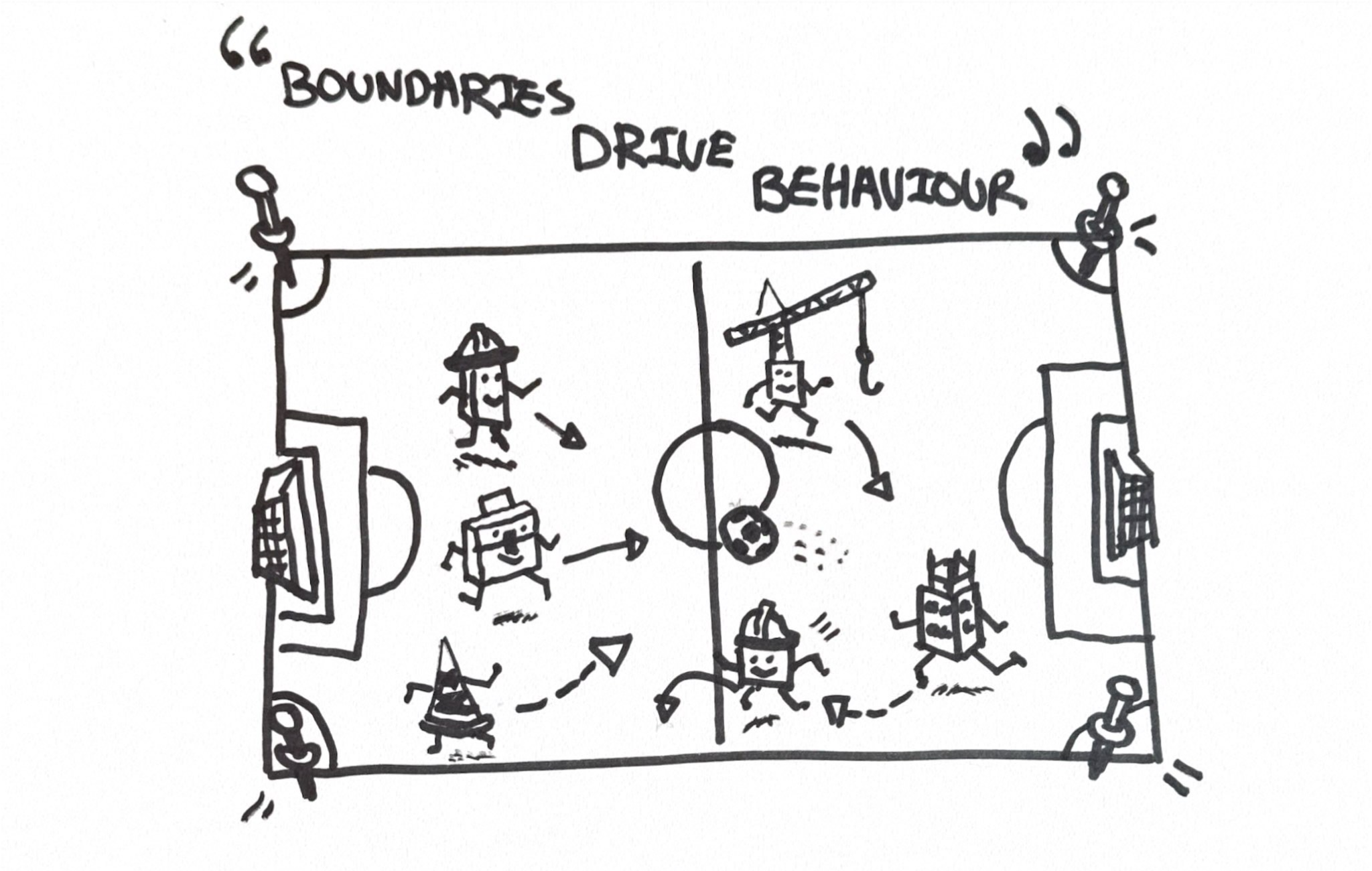
With soccer on everyone's mind, imagine a field with no boundaries.
No sidelines.
No goal lines.
No penalty box.
No clock.
Would that create more freedom?
Maybe for a few minutes.
Then it would become chaos.
Players wouldn't know where to position themselves.
No one would know when the game had stopped.
The objective would become unclear.
The boundaries don't restrict the game.
They make the game possible.
Great coaches understand this.
They don't just coach by giving instructions.
They coach by changing the constraints.
Shrink the field and players must think faster.
Limit touches and the ball has to move quicker.
Increase the pressure and teammates learn to communicate, scan and adapt.
The constraint becomes the coach.

Lionel Messi grew up playing futsal; a faster, smaller version of soccer played on a hard court with fewer players and far less space.
Less time.
Less room.
More pressure.
More touches.
The smaller game didn't limit his potential.
It helped develop it.
Projects work the same way.
Budget.
Schedule.
Building code.
Site access.
Weather.
Material availability.
Existing conditions.
We often describe these as obstacles.
But they're also the conditions that shape better thinking.
A clear budget forces prioritisation.
A compressed schedule encourages smarter sequencing.
A remote site makes prefabrication more attractive.
A Big Room creates shared attention.
A pull plan builds commitment.
A decision log creates accountability.
Good constraints don't remove creativity.
They give it direction.

One of the most powerful leadership tools is asking better constraint-based questions.
What would we build if the budget were cut in half?
Not because the budget actually will be, but because the question reveals what's essential.
What would we do if we only had half the time?
Suddenly the conversation shifts toward prefabrication, procurement, simpler details, faster decisions, and fewer handoffs.
The constraint exposes possibilities that weren't obvious before.
That's why the same people often behave differently in different systems.
Leadership isn't about managing every action.
It's about designing the conditions that make the right actions easier.
Because when the boundaries are clear...
The team knows how to play.