
When the HiPPO Enters the Room
Every project meeting has group norms.
Some are intentional.
Most simply evolve.
One of the most powerful (and most dangerous) shows up quietly.
The highest-paid person speaks.
Everyone else begins adjusting their thinking.
It has a name: the HiPPO effect- the Highest Paid Person's Opinion.
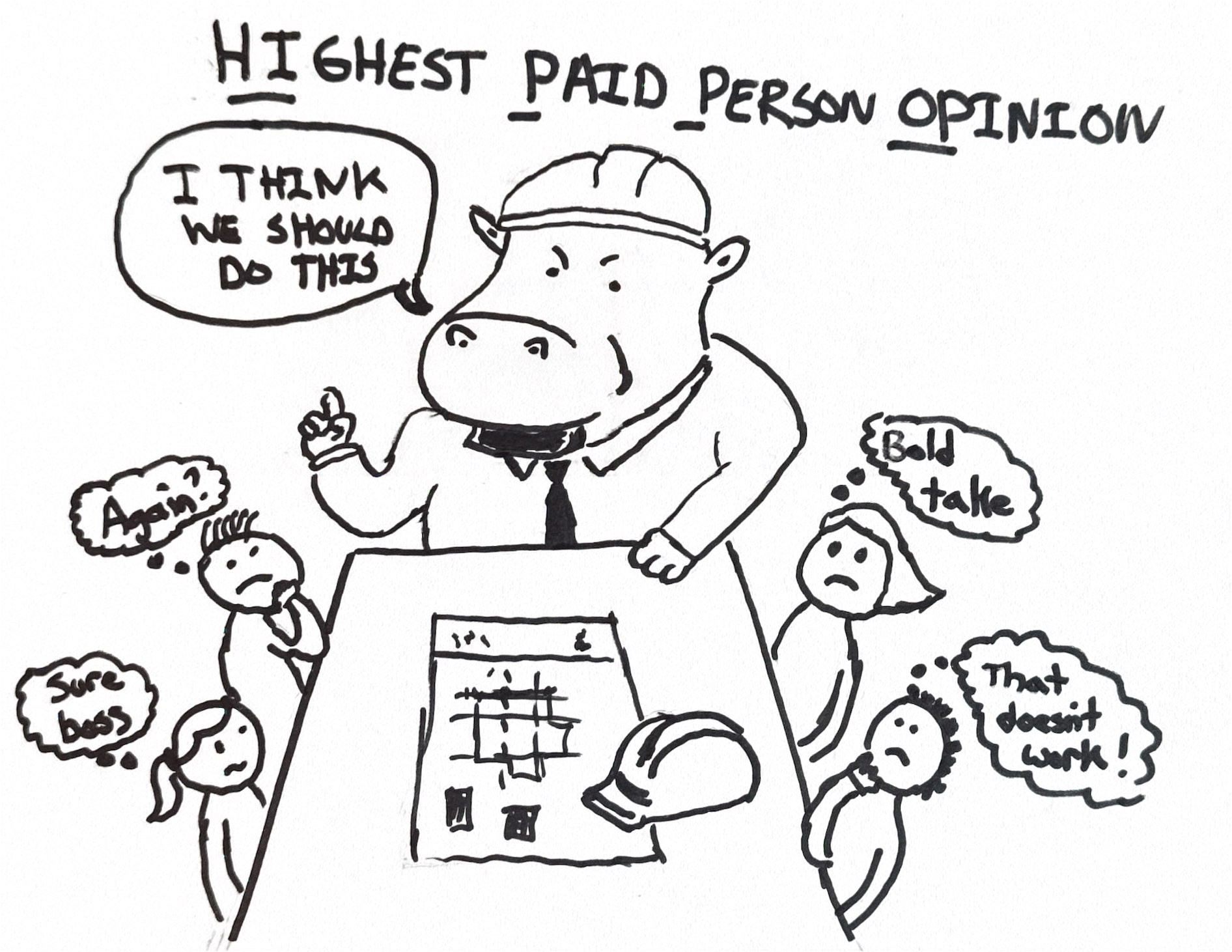
It happens in boardrooms, Big Rooms, design meetings, budget reviews, site coordination calls, and project debriefs.
Most of the time, no one notices it's happening.
No one walks into a meeting thinking, Let's ignore the best idea and follow the most senior person.
But the room changes.
People read the hierarchy.
Junior voices become more cautious.
Experienced professionals soften their disagreement.
Alternative ideas stay unspoken.
The meeting still feels collaborative.
Everyone contributes.
The minutes get recorded.
Action items are assigned.
But the conversation has already been anchored.
And that matters.

A building is shaped by thousands of decisions.
Some are obvious; budget, structure, schedule, materials, constructability.
Others are quieter: who speaks first, who feels comfortable challenging an assumption, whose concerns are explored, and whose ideas never make it into the conversation.
If the HiPPO dominates the room, the project loses access to the expertise it already brought together.
On complex projects, that's an expensive mistake.
The person closest to the issue isn't always the person with the most authority.
Sometimes it's the project coordinator who notices a recurring issue.
Sometimes it's the superintendent who has built it before.
Sometimes it's the consultant who sees a downstream consequence no one else has considered.
Good leadership doesn't silence those voices.
It creates space for them.
The goal isn't to remove hierarchy.
Projects need leaders.
The goal is to ensure leadership doesn't unintentionally become gravity.
Because once the HiPPO speaks too early, ideas begin orbiting around authority instead of evidence.
Fortunately, a few simple meeting habits can help.
Start with the evidence.
Review the data, drawings, constraints, risks, schedule impacts and trade-offs before anyone shares a preferred solution.
Capture independent thinking.
Ask participants to write down their preferred option before discussion begins. It protects fresh thinking before consensus pressure takes over.
Invite every discipline to challenge the decision.
Instead of asking, "Does everyone agree?" ask each discipline, "What concerns you most?"
That single question often uncovers risks that would otherwise stay hidden.
Strong group norms don't eliminate disagreement. They make it safe.
Because collaboration isn't about everyone thinking the same way.
It's about giving every perspective the opportunity to improve the outcome.

Leadership should guide the conversation.
It should never end it.
Because the best idea in the room isn't determined by job title.
It's determined by how well the room makes space for it.