
The Map Is Not the Terrain
What if the building code didn’t exist?
Anarchy in the streets?
Buildings falling down?
Engineers running around, lost and confused?
Maybe not.
The first National Building Code of Canada was published in 1941.
So what did engineers do before that?
They designed.
They sketched.
They observed failures.
They learned from what worked and what didn’t.
They relied on first principles, experience and judgment.
Most of the engineers who practiced before that era are now retired.
As we lose that generation, we’re not losing technical knowledge, we’re losing design philosophy.
We see this tension often, especially when mentoring students or younger engineers.
What happens if we don’t meet the code?
Do we get in trouble?
Is our license taken away?
These are fair questions.
The building code is essential.
It represents decades of collective learning, research, testing and hard-earned lessons. It has dramatically improved safety.
But an over-reliance on the code isn’t serving us.

In an age of powerful software (with building codes embedded directly into analysis tools) and under constant pressure of time and fees, it’s easy to fall into a trap:
Designing in reverse.
Starting with compliance.
Letting software lead.
Asking if it passes before asking if it’s right.
When that happens, we skip the most important step in any design process: judgment.
The problem isn’t the code.
It’s when we use it.
The code is written as a one-size-fits-all document.
It must simplify reality to cover many building types, climates and conditions.
Sometimes that makes it conservative.
Sometimes it doesn’t go far enough.

Understanding the code through a first-principles lens allows engineers to interpret it, not just apply it.
Structurally, wind and snow loads are prescribed broadly.
They’re reasonable for many buildings, but not perfect for any one building.
On some projects, targeted wind or snow studies can better reflect actual conditions.
When the cost of testing is offset by structural efficiency, it’s worth serious consideration.
Foundation design relies heavily on project-specific geotechnical parameters that are not explicitly defined in the Building Code.
Structural and geotechnical engineers must work together, using judgment to select appropriate foundation systems. While these parameters are carefully developed, they are often based on a limited number of boreholes attempting to represent an entire site.
Additional testing can refine seismic classification, bearing assumptions and performance, leading to designs that are more realistic and, in many cases, more cost-effective.

There are also things the code doesn’t fully capture.
The code is focused on life safety.
It doesn’t adequately describe the human experience.
Deflection limits exist.
Detailed vibration criteria often don’t.
The result? Buildings that meet code, but feel bouncy, crack excessively or generate occupant complaints.
These aren’t failures of the code.
They’re reminders of what the code is and what it isn’t.
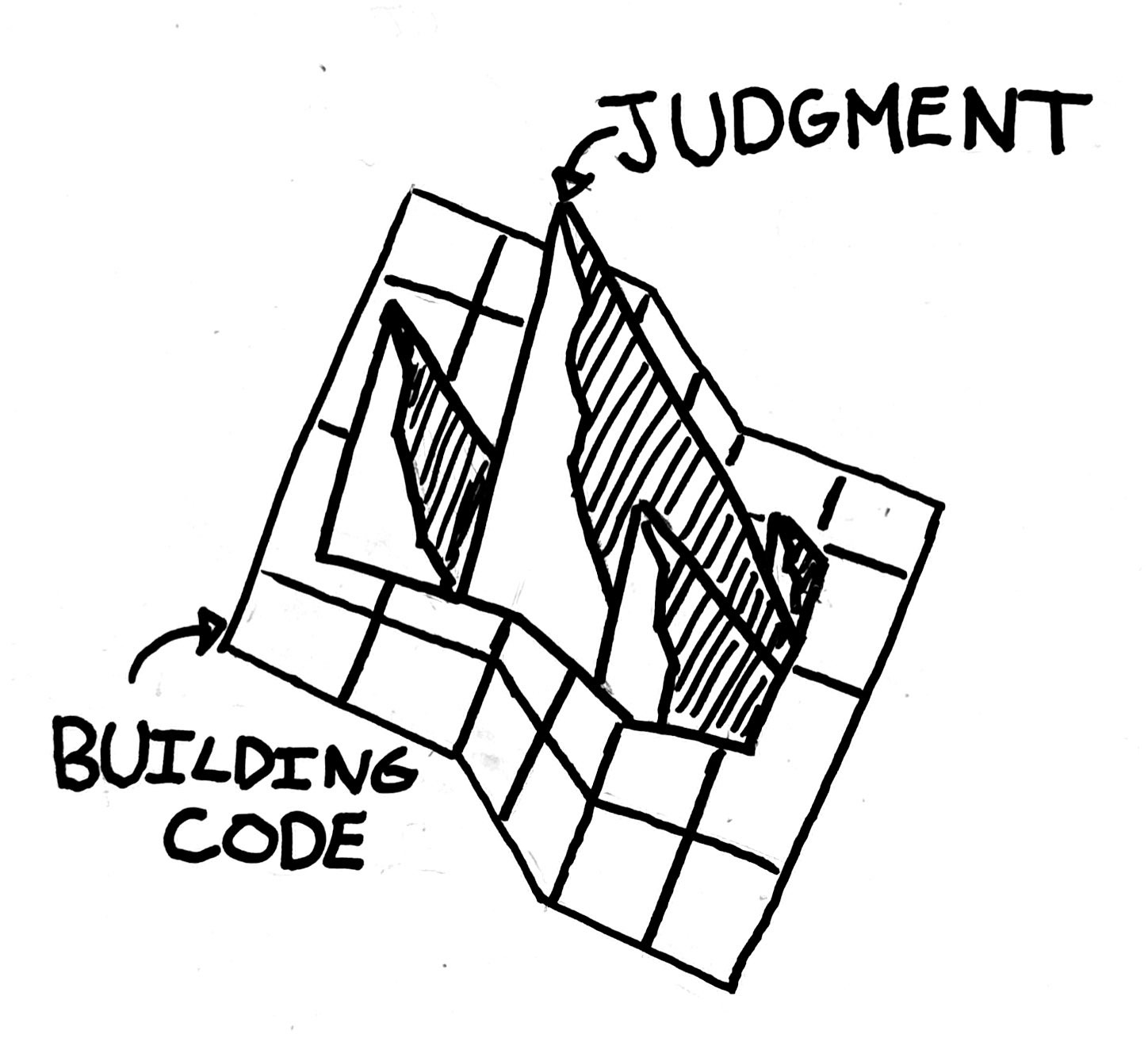
The code is a map.
Maps are essential.
They keep us from getting lost.
But no experienced hiker confuses the map for the ground beneath their feet.
Judgment is the terrain where real decisions are made.
We didn’t become professionals because we know how to follow the code.
We became professionals because we know when not to rely on it alone.