
The Last Responsible Moment
If you've worked on a collaborative delivery project lately, you've probably heard the phrase:
The Last Responsible Moment.
It comes up in Pull Planning sessions, owner discussions, design meetings.
And at first, it sounds completely backwards.
Why would waiting to make a decision ever be better than making it today?
We're taught that good leaders decide quickly.
Waiting can feel indecisive.
It can look like a lack of ownership.
Or worse, procrastination.
But that's not what the Last Responsible Moment means.
It's not about delaying work.
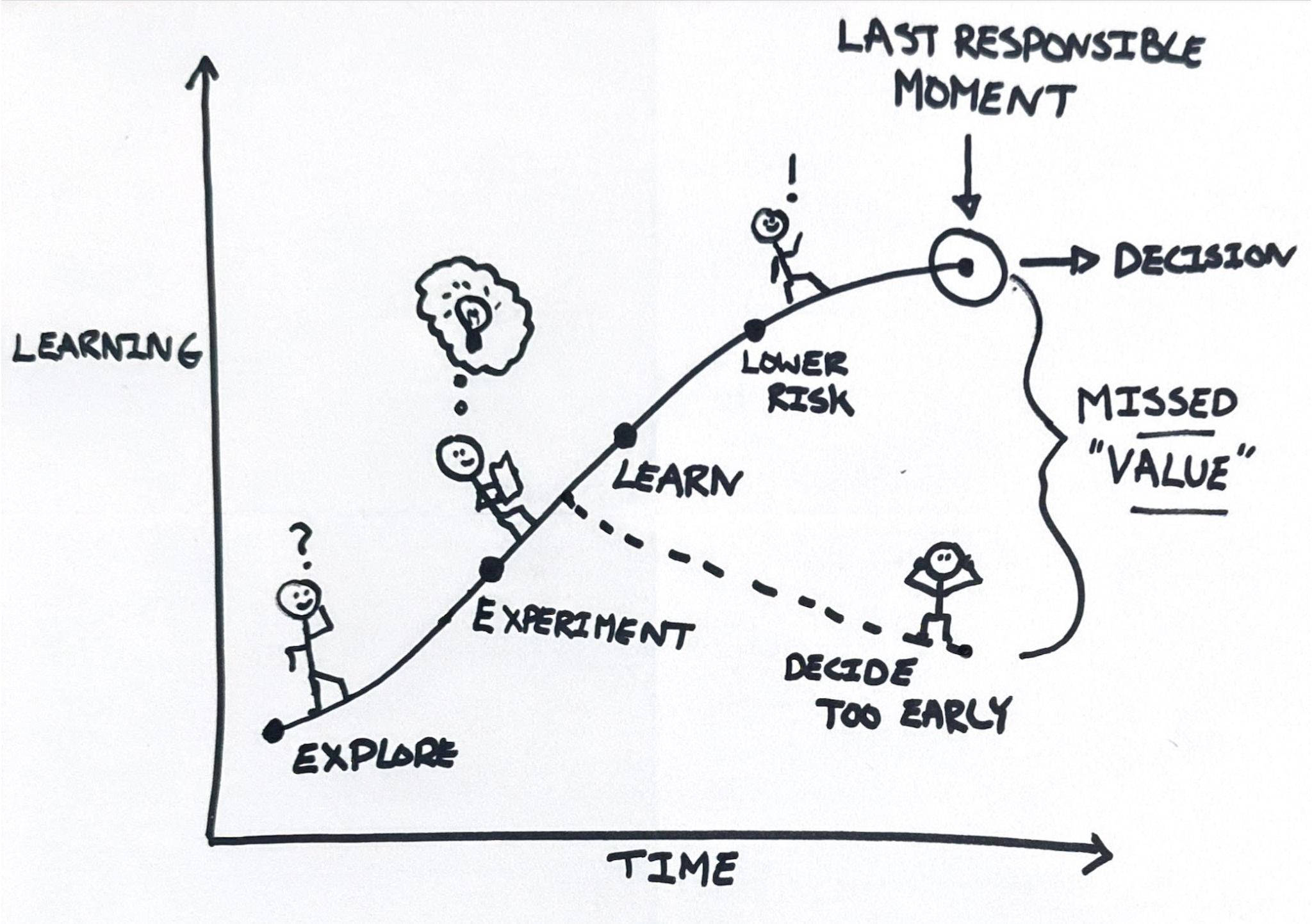
It's about delaying commitment while continuing to learn.
The Last Responsible Moment is the latest point a decision can be made without delaying others or eliminating valuable options.
Notice the important word isn't last. It's responsible.
Without one critical ingredient, waiting really is procrastination.
That ingredient is learning.
A team practicing the Last Responsible Moment isn't standing still.
They're exploring options.
Testing ideas.
Coordinating across disciplines.
Validating assumptions.
Reducing uncertainty.
The work never stops.
Only the final commitment waits.
As structural engineers, we experience this tension constantly.
Foundations need sizing before the architecture is fully resolved.
Column grids influence nearly every discipline.
The pressure is familiar.
"Let's lock it in and keep the project moving."
Sometimes that's the right call.
But often, we've found it's better to commit at the last responsible moment.
Not because we're avoiding the decision. Because we're improving it.
Rather than rushing a foundation package that may require significant revision later, we'd rather spend another week learning.
Sketching options.
Testing layouts.
Coordinating with the architect.
Understanding the implications of each choice.
Every conversation improves the quality of the final answer.
What we're delaying isn't the work.
We're delaying the commitment until today's decision is genuinely better than yesterday's.
Why does that matter?
Because every day a decision stays open, the team has an opportunity to learn.
Owner priorities become clearer.
Risks emerge.
Trade partners contribute constructability insights.
Better ideas surface.
Lock a decision too early, and that new information often returns as RFIs, redesign, change orders or rework.
Wait until the right moment, and the decision reflects what the team has learned, not what they assumed.
Of course, there is a line.
Waiting without learning isn't Lean.
It's procrastination.
But waiting while actively reducing uncertainty?
That's strategy.
The best decisions aren't the ones made the fastest.
They're the ones made with the greatest understanding.
Because the measure of a great decision isn't how quickly it was made.
It's how much the team learned before making it.