
What Are You Optimizing For?
Choosing a structural system sounds technical.
It’s not.
It’s value-based.
Steel.
Concrete.
Wood.
Prefab.
Precast.
All of them work.
That’s the problem.
Because now… how do you choose?
Most teams go here first:
“Let’s keep costs down.”
“Let’s do what we’ve done before.”
“Let’s figure it out later.”
It feels practical.
It often isn’t.
Because every system is playing a different game.
Steel wants speed and flexibility.
Concrete wants durability and performance.
Wood wants simplicity and cost.
Prefab wants efficiency and repeatability.
You’re not choosing a system. You’re choosing what matters.
And if you don’t say it out loud early… it gets decided anyway; by habit, by bias, by whoever speaks first.

There are really only two paths.
Option 1: Decide by default
Cheap now.
Pay later.
Option 2: Decide by values
Clear now.
Intentional later.
This is where Choosing by Advantages comes in.
Not as a formal process. More as a way of thinking.
It starts with a simple shift:
Put value before dollars.
Decide what matters first, and then price it.
Say those priorities out loud early, because if you don’t, the team will still make a decision… just without clarity.
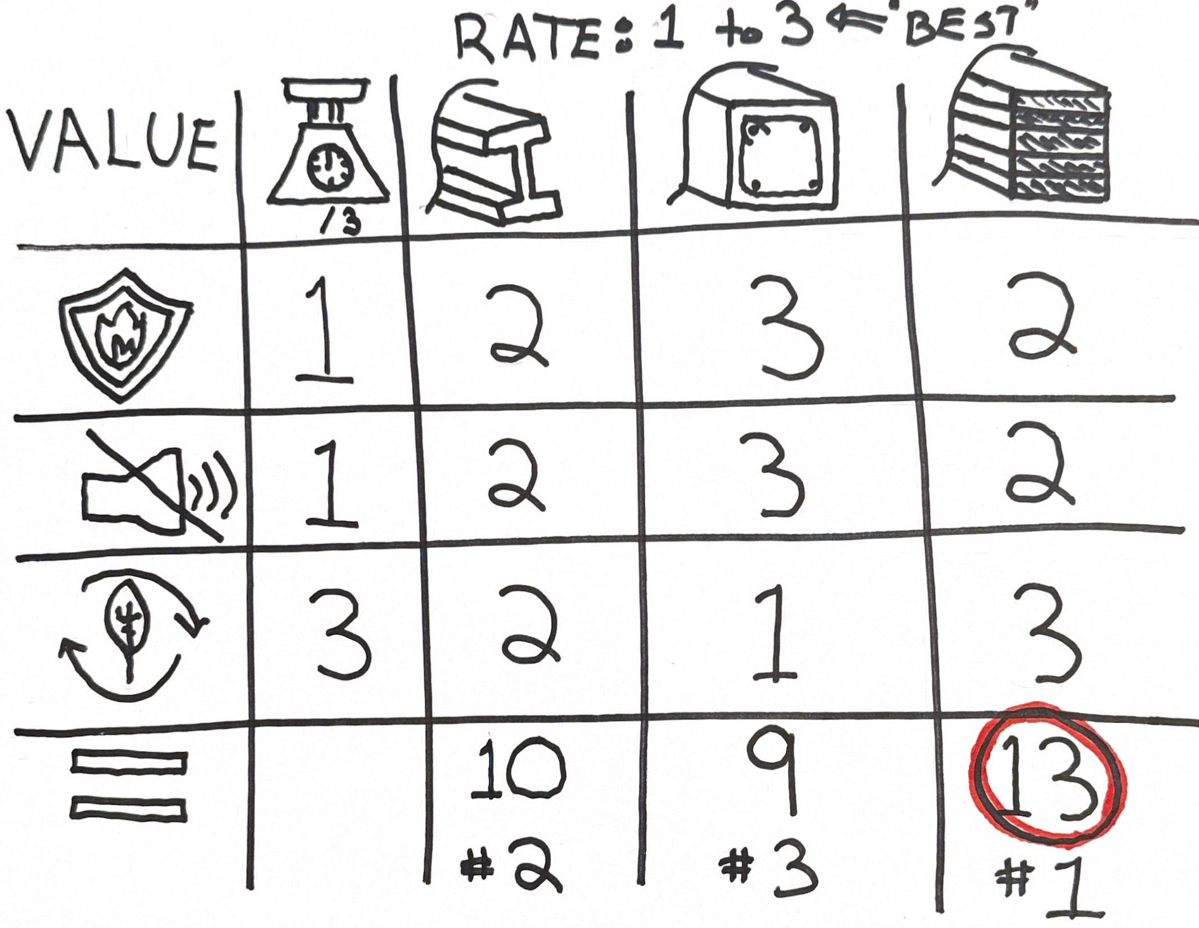
What this really does is make the trade-offs visible.
Every system wins somewhere.
Every system loses somewhere.
Instead of guessing, you put it on the table.
You get everyone in the room.
You talk it through.
You decide together.
When the “why” is clear, something changes.
You stop second-guessing.
You stop circling back.
The decision holds.
Simple version?
Choosing by Advantages turns opinions into decisions.
Because here’s the truth:
You don’t get everything.
You get what you choose to value.
Great buildings happen when teams decide what matters first…
and then choose the system that proves it.