
Where Good Projects Get Stuck
Collaborative design has a strange problem.
Everyone can be working hard, and the project can still feel slow.
Meetings are happening.
Drawings are moving.
Questions are being asked.
Emails are flying.
People are busy.
But busy is not the same as flow.
In The Goal, Eliyahu Goldratt introduces the Theory of Constraints.
The idea is simple:
Every system has a constraint.
One point that limits the output of the whole system.

In a factory, it might be a machine.
In a design team, it is usually harder to see.
The bottleneck might be:
A decision.
A missed deadline.
A senior review.
A hidden handoff.
A conversation that has not happened yet.
That is what makes knowledge work tricky.
The inventory is not stacked on the floor. It is stacked in people’s heads.
Half-made decisions.
Unclear priorities.
Waiting questions.
Open loops.
Drawings that are 80 percent done.
Issues that are “almost resolved.”
So how do you see it? How do you get ahead of it?
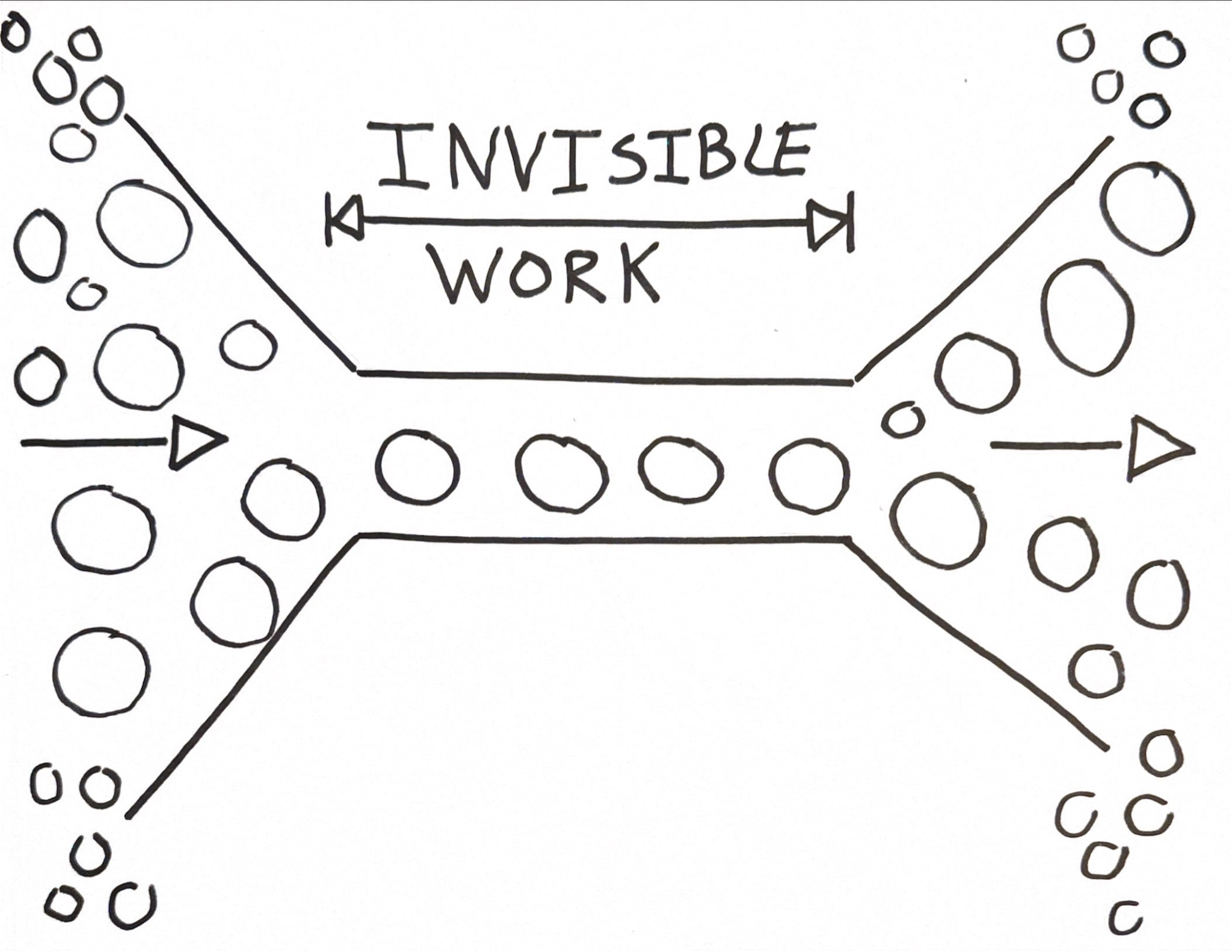
You make the work visible.
Because this is where good projects get stuck.
Not because people do not care.
Because the work is not visible enough.
1. Decisions
Track your decisions as a team.
What decision was made?
Who made it?
Why?
If decisions are not visible, they get reopened and discussed again.
That is decision rework.
2. Deadlines
“We need it soon” is not a plan.
“What do you need, by when, and for what?” is a plan.
Deadlines need to be visible so the team can see the runway.
That is where flow starts.
3. Handoffs
Most handoffs are invisible.
Architect to Structural.
Mechanical to Structural.
Team to estimator.
Reviewer back to designer.
Work often looks active when it is actually waiting.
The project does not need more motion. It needs clearer movement.
4. Review
Senior judgment is valuable.
But when everything needs the same few people, they become the bottleneck.
You know who you are.
The hero.
The fixer.
The one carrying too much.
Make review visible so experience is used well, not overloaded.
5. Work in Progress
Too many open issues slows everything down.
Too many started tasks means too much to remember, manage and restart.
It feels productive because everything is moving.
But movement is not the same as flow.
Too much work in progress creates drag.

The Shift
The answer is not to push harder.
The answer is to make the work visual.
What is open?
What is ready?
What is active?
What is waiting?
What needs a decision?
Once the work is visible, the bottleneck starts to reveal itself.
Make the work visual, and the project starts telling the truth.